
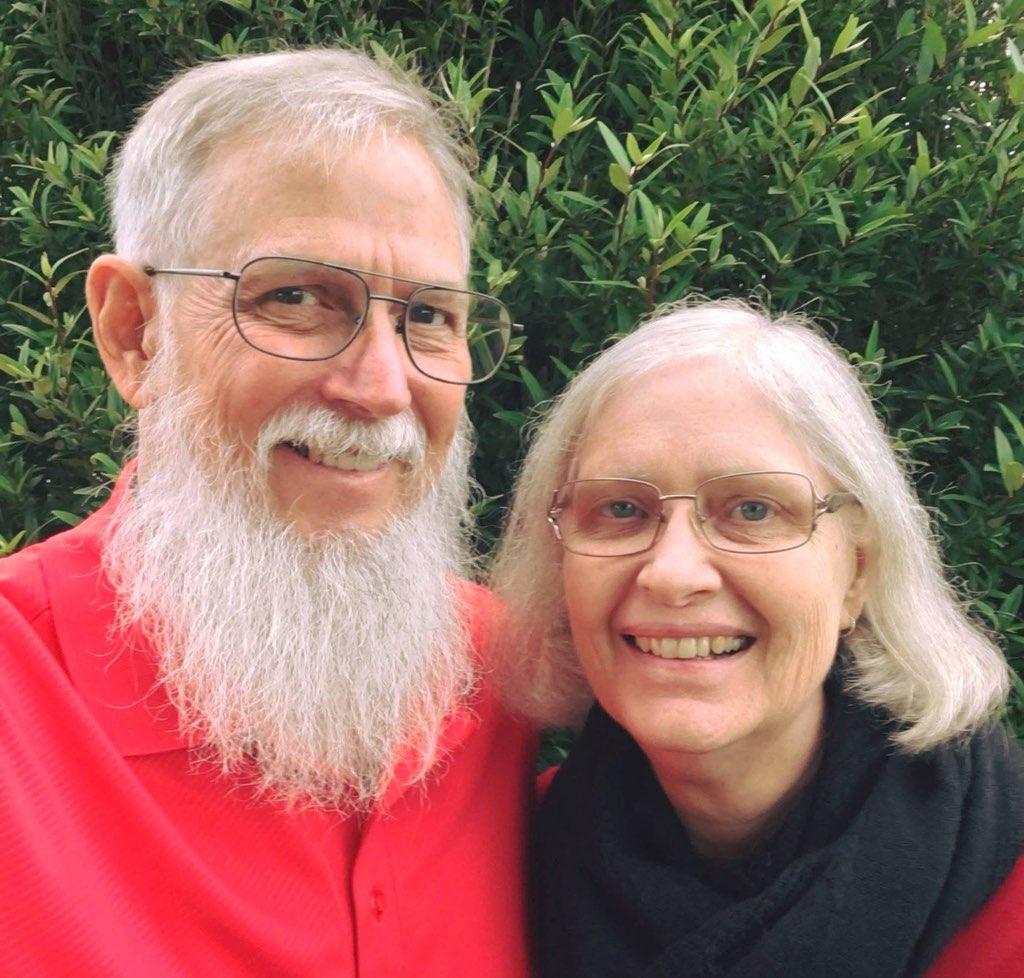
The Butlers & Pioneer Bible Translators
William and his wife Robin have served with Pioneer Bible Translators since 1978. They lived with their two children in a remote jungle village in Papua New Guinea. William facilitated the translation of the New Testament into the Waran language, which was dedicated in 2019. He now serves as a consultant for other translation projects while facilitating the Waran Old Testament.
If you’d like to know more about how God has been working among the Waran people of Papua New Guinea, here’s a video: https://pioneerbible.org/videos/gods-word-for-the-waran/
Working for God in Papa New Guinea
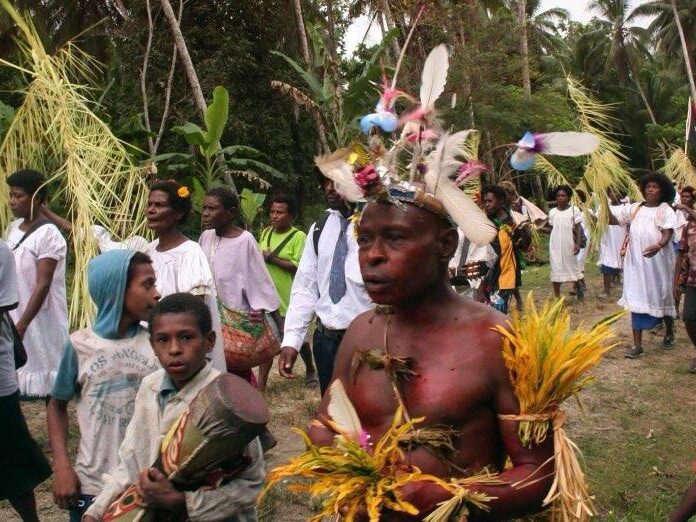
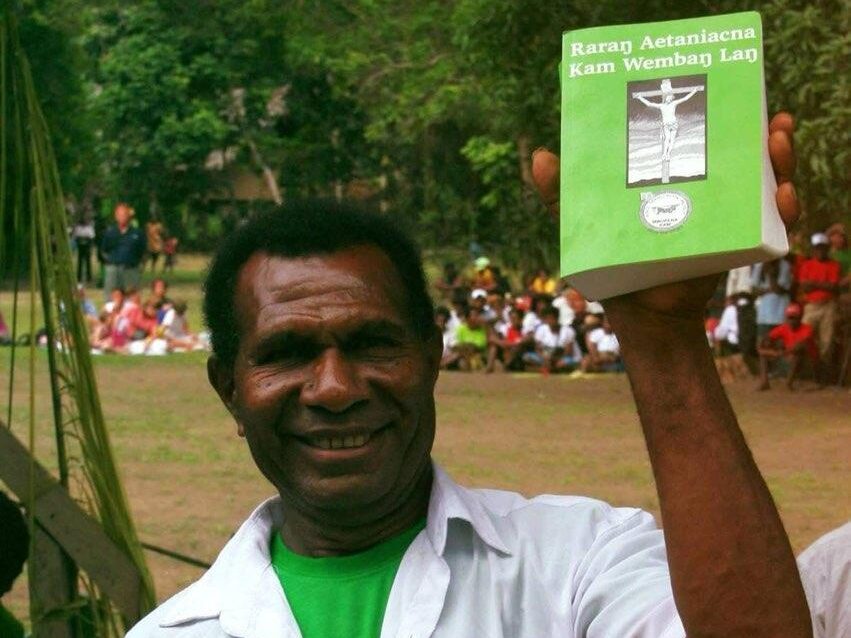
- First book completed in the Waran language! This is the book of John.
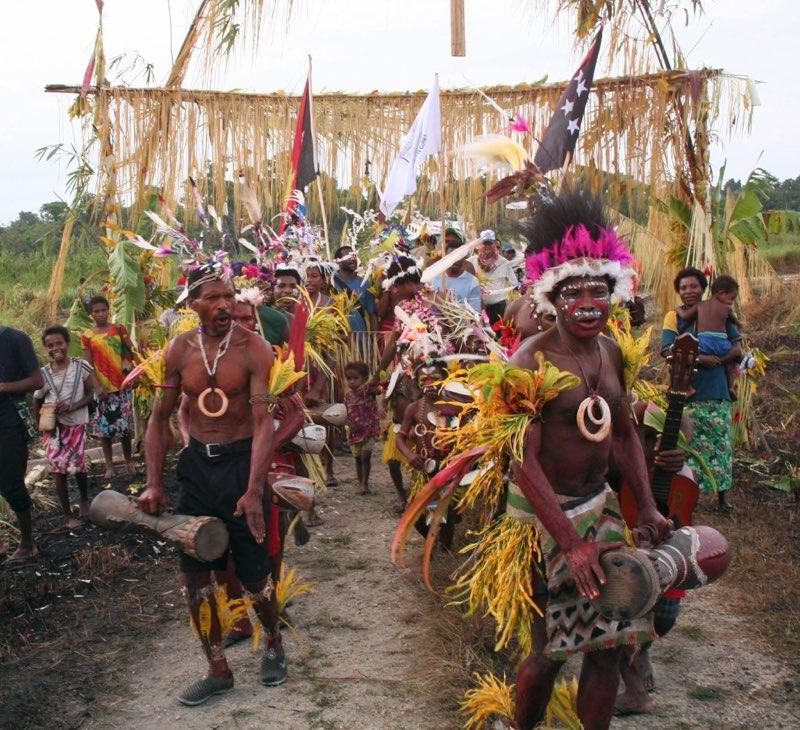
God’s Word for the Waran People
Waran: New Testament Celebration
The Beginning…
In 1975, at a snowy National Missionary Convention in St. Louis, William and his fiancée, Robin True, went forward to give their lives to the work of Bible translation. In 1976, Pioneer Bible Translators officially became an organization at about the same time the Butlers were married. By 1979, the Butlers finished preparing and raising support and went to Papua New Guinea to begin helping the Waran people translate the Bible into their language.
To reach their new home, the Butlers flew to a remote airstrip and then took a canoe out to live among the 3,000 Waran people. The language had no alphabet back then. For 40 years, they strove to see the day the Waran people would have the Word of God in their language. To be clear, it doesn’t always take 40 years. In other settings, translation of the New Testament might take 5, 10, or 20 years. William invested a lot of time training translation teams for other languages; he also served the Papua New Guinea branch in the area of finance. William and Robin’s servant hearts stretched out the time frame quite a bit.
Then, at last, after four decades of painstaking effort, the Waran people finally celebrated the dedication of the New Testament in their language on June 23, 2019. I don’t remember William ever talking about the work of Bible translation among the Waran without tears of passion and a tightened voice, evidence of the deep emotional zeal that fueled and sustained four decades of energetic, meticulous labor for the Lord. When I think about William and Robin, this Scripture springs to mind: “The world was not worthy of them” (Hebrews 11:38).
Translating the Bible into Sign Language
Among Bible translators, the most neglected group might be the 70 million people in the world who are Deaf. There is no universal sign language; instead, an estimated 400 sign languages exist in the world. In the region around Australia, for example, more than 10,000 Deaf people communicate in Auslan (Australian Sign Language) and up to 30,000 use Papua New Guinean Sign Language. The Deaf Bible Society estimates 98 percent of Deaf people have never been introduced to the gospel. The time has come for the church to stop behaving as if Jesus died only for hearing people.
PBT and our Bible translation partners are gearing up to meet this need together. We aren’t satisfied to leave people who are Deaf and hard of hearing for last. And so we are preparing to send out Deaf missionaries who will start Bible translation projects among the sign languages of the world. (For more on Bible translations in sign languages, go to “Seeing God’s Words Come to Life,” on page ##.)
So Much More Work to be Done
That celebration back in June was exciting, but the challenge is still before us, as the Pacific islands around Australia still harbor hundreds more small languages lacking the Word of God. Papua New Guinea alone has 837 languages with a possible need for translation in about 270. Indonesia has 684 languages, 280 of which have a potential need for Bible translation. There are 108 languages in Vanuatu, a tiny cluster of islands northeast of Australia, and just under half are thought to still need Bible translation.
The awesome scope of the remaining work in the islands stretching from east to west all across the northern coast of Australia staggers the mind. But William Butler and others like him in the Bible translation movement have an irrepressible passion to reach every last one. Those among us who have had the pleasure of knowing and living among the Bibleless peoples of the world are inspired to reach them. Because we know them intimately, we can better understand why God might place infinite value on each soul. The valuable people scattered over these islands inspired William to coin this tagline for our Papua New Guinea branch: “To the Least and the Last.” How will God meet this great need?
God has already begun to move in great power! Forty years ago, when William and Robin first went to Papua New Guinea, Pioneer Bible Translators was just starting our first few language projects. It took 30 years to translate the Bible into 35 languages spoken by 9 million people in 5 countries. But God has accelerated the pace! Today we are translating the Bible into 92 languages spoken by 43 million people in 18 countries. We are adding three more countries to our work this year alone!
The remaining task is great, but so is the momentum of the entire Bible translation movement. So much is happening right now that it’s unclear how many translation projects are started each year. New Bible agencies, local translation endeavors, and whole Bible translation movements continue to arise, to the amazement of those of us who have worked in obscurity on this task for our whole lives.
I estimate our partnering Bible agencies may be starting more than 150 translation projects every year. Working seamlessly in unity together with our many partners, we aspire to start every remaining Bible translation project needed worldwide by 2035, and to work toward having the New Testament in every language that needs it by 2050—yes, even the ones in Papua New Guinea.
Pioneer Bible Translators is building momentum to bite off our part of the remaining task; we anticipate we will begin 200 more translation projectsbefore the world runs out of languages in need of first-time translation projects.
More and more people and resources are being sent to smaller parts of the world. But the complexity and linguistic diversity in this particular region and the surrounding island nations is so great, we are likely to finish this great translation task in the same place we started, Papua New Guinea—where we have the greatest number of the smallest languages on earth, “the least and the last.”
“Oh, Sorry!” By: William Butler
Every day, from early morning until late afternoon and even some evenings, we’d been poring over the translation of Mark’s Gospel into the Waran language. Innumerable questions had been asked, each one designed to help us discover whether the translation communicated the Biblical message with clarity and accuracy. Any hint of miscommunication or obscurity led to further questions until the translation team was satisfied the translation faithfully transmitted God’s message.
One of the faithful members of this checking team was Mindo. An older man and former village representative in the local government council, he was well-respected in the community. His knowledge of the Waran language was immense. He was of an age that he no longer went out daily to work in his garden, so he was almost always available for checking sessions. We welcomed him as a valuable part of the team.
However, the week was difficult for Mindo. He wasn’t accustomed to sitting non-stop for such long periods of time. The constant mental strain of listening to and evaluating every phrase was exhausting. Occasionally, Mindo would nod off in the heat of the afternoon.
How much of the message in Christ’s words, I wondered, could be getting through to him?
Then we came to Mark 14, which details the arrest and subsequent mistreatment of Jesus. As the account of the arrest was read aloud, Mindo at first perked up. However, as Jesus was led before the Council and liars came in to give testimony against Him, Mindo lowered his head and kept his eyes on the floor. I thought he was dozing off again.
When verse 65 was read aloud, Mindo began to murmur. At each new humiliation heaped on Jesus, Mindo’s quiet vocalization became slightly louder. Finally, I could understand him. He was saying, “Oh, sorry, sorry.” With each report, his head sank a little lower and his eyes bored more deeply into the floor.
The Council spit on Jesus and hit Him with their fists.
“Oh, sorry.”
The guards slapped Him.
“Oh, sorry, sorry.”
Peter denied Him.
“Oh, so sorry.”
The crowd shouted, “Crucify Him! Crucify Him!”
“Oh, sorry, sorry.”
The soldiers drove a crown of thorns down on His head and mocked Him.
“Oh, sorry.”
They led Him away and crucified Him.
“Oh, sorry, sorry.”
Mindo had heard this story before, but always in another language. Now, as he heard it for the first time in his own language, he vividly relived the last hours of Christ’s life. It was a deeply emotional and powerful experience. He felt the shame and humiliation Jesus suffered. He felt his own personal shame because he realized that Jesus endured each of these things for him. He saw, as he had never seen before, Jesus, Son of God, Savior. In response he assumed the posture, not of sleep, but of embarrassment and shame as the Waran people express it.
Hearing these words for the first time in his own language, Mindo vividly relived Jesus’ suffering and humiliation.
Mindo is no longer with us. He has gone on ahead to see face to face the Christ who suffered for him. He left behind a rich witness of the power of God’s Word to touch our hearts when we hear it in our own language. Even today, decades later, as I read the story of Jesus, I feel what Mindo felt. He, “being dead, yet speaks” to me.
May everyone who reads or hears the Word as it goes forth in the language of their hearts be as personally and emotionally affected as Mindo. Then the Christ of history will become the Living Christ with power to challenge and transform their lives.